
The Silent Drain
| How unaddressed mental health is costing your SME in productivity, people and profit |
Most SME owners didn’t go into business to become part-time occupational health managers. And yet, for many, that’s quietly become part of the job description.
Staff pulling sickies that don’t feel quite like sickies. A team member who is always there but never quite present. A talented person handing in their notice citing “personal reasons.” These are the everyday symptoms of something that UK employers are losing £51 to £56 billion to every single year.
Poor mental health in the workplace isn’t a fringe issue or a soft one. It sits on your bottom line. It affects your capacity to deliver, your ability to keep hold of good people, and your reputation as the kind of employer others want to work for. Furthermore, for a business with a small or lean team, the ripple effect of one person struggling is felt by everyone.
This report doesn’t tell you that wellbeing matters because it’s the right thing to do. You know that already. Instead, it shows what the data says it actually costs you, where the hidden pressure points are, and what practical steps can make a measurable difference. It also explains how private medical insurance with proper mental health cover fits into that picture.
The Numbers Behind the Noise
Let’s put some figures to something that often feels abstract. Crucially, these aren’t projections from a think tank with an agenda. They’re drawn from Deloitte, the Health and Safety Executive, the British Medical Association, and others.

That last figure is worth sitting with. Nearly two thirds of the British workforce are showing signs of burnout. Not “sometimes tired.” Not “could do with a holiday.” Clinically recognised burnout: exhaustion, emotional detachment from work, and a That last figure is worth sitting with. Nearly two thirds of the British workforce are showing signs of burnout. Not “sometimes tired.” Not “could do with a holiday.” Clinically recognised burnout: exhaustion, emotional detachment from work, and a measurable decline in performance. As a result, the proportion has grown by 12 percentage points in just two years.
One in six employees is currently experiencing a mental health problem at work. In a team of twelve, that means statistically two of your people are affected right now, whether you know it or not.
The scale of it is significant at a national level. However, for an SME owner looking after 20, 50, or 200 employees, it is immediate and personal. These are real people, and real costs sitting in your workforce today.
The Silent Drain – The Three Ways It Hits Your Business
Poor mental health doesn’t impact your business in one obvious way. Instead, it tends to work across three fronts simultaneously, and the most expensive of those is the one you cannot see.
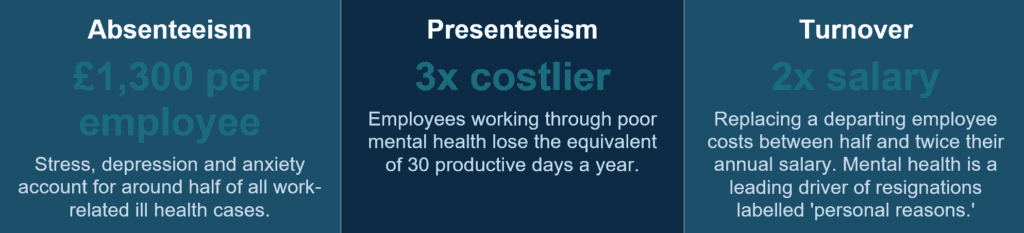
Of these three, presenteeism is the silent thief. The employee who calls in sick is visible. In contrast, the employee who shows up but spends the day staring at a screen, responding slowly, making small errors, and keeping their head down is invisible. Deloitte estimates that presenteeism costs UK employers around £24 billion annually, roughly half the total cost of poor mental health.
As a result, the employee who shows up and struggles in silence is where the real cost lives.
Financial Stress: The Accelerant Nobody Talks About
Mental health challenges rarely arrive from nowhere. For many employees, the trigger isn’t the job itself. It’s what’s happening at home. And in 2025, for a significant proportion of your workforce, what’s happening at home is financial anxiety.

These are not fringe concerns. For example, an employee worrying about their mortgage on a Monday morning is not going to be thinking about your Q2 targets. Similarly, an employee who lost sleep on Sunday over a credit card bill will be slower, more distracted, and more prone to mistakes on Monday.
With 4.2 million working days lost every year specifically to financial stress-related absence, the cumulative toll is substantial. Consequently, financial wellbeing and mental wellbeing are not separate topics. They are the same conversation.
The Manager in the Middle
Here is a finding that tends to surprise employers, and probably shouldn’t. According to 2025 research, 69% of employees say their manager has a bigger impact on their mental health than their salary, their company policy, or even their doctor. In fact, managers ranked alongside spouses and partners in terms of day-to-day influence on how employees feel.
The Manager Effect Is Real – Your managers are already influencing the mental health of your team every day, whether or not they know it. Without the right training and support, they’re being asked to operate as informal mental health first responders, often without the tools, vocabulary or confidence to do so.
This doesn’t mean expecting every team leader to become a qualified counsellor. Instead, it means creating the conditions where early conversations can happen. A manager who can notice that someone isn’t quite right, and knows how to open a door without making it awkward, reduces the escalation of manageable problems into serious ones. That is where the real costs live.
As a result, companies that build a culture of mental health awareness experience, on average, a 20% improvement in employee retention. For a business where losing one key person can feel like the walls shake, that matters enormously.
The NHS Reality: Why Waiting Isn’t Working
The NHS remains an extraordinary institution, and this isn’t a piece designed to undermine it. However, when it comes to mental health treatment, the honest picture is one of significant, sustained pressure.
| Metric | Detail | Figure |
| NHS mental health waiting list | Number of people waiting for treatment (BMA, 2025) | 1.7 million |
| Median NHS community wait | Average wait for community mental health services | 45 days |
| 90th percentile NHS wait | Longer waits affecting 1 in 10 patients | 251 days |
| Mental vs physical health waits | Times more likely to wait 18+ months | 8x longer |
| Typical PMI access | Time to access therapy or CBT via private cover | Days, not months |
At the 90th percentile, people are waiting over 250 days for community mental health treatment. For an employee in crisis, eight months is not a waiting time. It’s an absence waiting to happen, or a resignation building.
As a result, relying solely on the NHS isn’t a strategy. It’s a hope.
The PMI Advantage – With a quality PMI policy that includes mental health cover, employees can typically access therapy, CBT, and psychiatric support within days rather than months. Therefore, early intervention is not just kinder. It is dramatically cheaper than managing a prolonged absence.
What Proactive Support Actually Looks Like
Proactive mental health support in an SME doesn’t require a large HR department, a dedicated wellbeing budget, or a ping-pong table. It requires intent, some structure, and the right tools.
- PMI with Mental Health Cover Confidential access to therapy, CBT, psychiatry and counselling within days.
- Employee Assistance Programmes (EAPs) 24/7 confidential phone and online support for employees dealing with stress, anxiety, or personal difficulties.
- Digital GP Access Same‑day digital GP appointments, enabling early referrals before a condition escalates.
- Early Intervention Focus Supporting people before they reach crisis point is significantly cheaper and more effective than crisis management after the fact.
Not all PMI policies cover mental health equally. For instance, some offer only a limited number of therapy sessions. Others exclude outpatient psychiatric treatment. Because of this, understanding exactly what is and isn’t covered is where independent advice makes a real difference.
Moreover, a well-structured PMI policy sits alongside a culture where managers are equipped, conversations are normalised, and people don’t feel they have to soldier on in silence. The policy is the infrastructure. The culture is what makes it work.
The Return on Investment
If there’s one figure from Deloitte’s research that deserves to sit somewhere visible in every SME owner’s office, it’s this one.

Early support – the kind that catches a problem at stage two rather than stage seven – consistently delivers the highest ROI, because it prevents longer, more expensive absences and the replacement costs that follow.
To put this in practical terms: for a business with 50 employees, if even five of them are experiencing mental health challenges at any given time, and two of those escalate into extended absences or resignations that could have been avoided, the financial case for a proper PMI policy becomes very straightforward, very quickly.
In addition, 52% of employees feel more engaged and productive when their employer provides access to counselling or wellness support. Productivity and loyalty tend to travel together.
This Isn’t Just for Large Businesses
There is a persistent assumption that comprehensive employee health benefits are for corporates, not SMEs. However, that assumption is worth challenging. Private medical insurance for small and medium-sized teams is more accessible and more flexible than many business owners realise.
Moreover, the cost of doing nothing – measured in absenteeism, presenteeism, and turnover – is almost always higher than the cost of a well-chosen policy.
What the Data Is Telling You
Poor mental health is not a soft issue sitting at the edges of your business. It is active, it is costly, and it is almost certainly present in your team right now.
The good news is that the research on returns is just as clear as the research on costs. Businesses that invest in proactive mental health support see measurable improvements in attendance, productivity, retention, and culture. Ultimately, you don’t need a large team or a large budget to make a meaningful difference. You need the right structure, the right policy, and the right guidance
READY TO FIND OUT WHAT’S RIGHT FOR YOUR BUSINESS?
Have a conversation with Jacob.
Book a call
Jacob is our private medical insurance specialist. He works with SME owners and HR teams across the UK to find PMI solutions that genuinely fit their workforce, their budget, and their situation. No jargon, no obligation, and no hard sell. Just a straightforward conversation about what’s available and whether it makes sense for you.
Sources & References
- Deloitte UK. Poor Mental Health Costs UK Employers £51 Billion a Year. Press release, updated December 2025. deloitte.com/uk/en/about/press-room/poor-mental-health-costs-uk-employers-51-billion-a-year-for-employees.html
- Health and Safety Executive. Work-Related Stress, Anxiety or Depression Statistics in Great Britain 2024. hse.gov.uk/statistics/causdis/stress.pdf
- Yomly. Workplace Mental Health Statistics for 2026: Key Data and Trends. October 2025. yomly.com/workplace-mental-health-statistics/
- WeCovr. UK Employee Mental Health Statistics 2026: The Burnout Data Roundup. February 2026. wecovr.com/guides/uk-employee-mental-health-statistics-2026-the-burnout-data-roundup/
- The Better Brain Company. Mental Health in the UK Workplace: Evidence Review and Strategic White Paper. February 2026. betterbraincompany.com/post/mental-health-uk-workplace-evidence
- British Medical Association. Mental Health Pressures Data Analysis. Updated March 2026. bma.org.uk/advice-and-support/nhs-delivery-and-workforce/pressures/mental-health-pressures-data-analysis
- Rethink Mental Illness. New Analysis of NHS Data on Mental Health Waiting Times. February 2025. rethink.org/news-and-stories/media-centre/2025/02/new-analysis-of-nhs-data-on-mental-health-waiting-times
- House of Commons Library. Mental Health Statistics: Prevalence, Services and Funding in England. Updated April 2026. commonslibrary.parliament.uk/research-briefings/sn06988/
- Zellis. Financial Wellbeing 2025 Report. November 2025. As reported in HRtech Cube. hrtechcube.com/financial-wellbeing-2025-report-reveals-surging-employee-stress/
- Stream. Financial Stress and UK Workplace Productivity. As reported in HR Grapevine, February 2026. hrgrapevine.com/content/article/2026-02-27-financial-stress-draining-productivity-as-4-in-5-workers-take-time-off-work-due-to-money-concerns
- Stribe. 14 Financial Wellbeing Statistics That Workplace Leaders Need to See. July 2025. stribehq.com/resources/employee-financial-wellbeing-statistics-uk/
- MHFA England. Key Workplace Mental Health Statistics for 2026. December 2025. mhfaengland.org/mhfa-centre/blog/workplace-mental-health-statistics-2026/
- Zurich UK / HR Review. Mental Health Crisis Could Cost UK £170bn as Workforce Participation Falls. April 2026. hrreview.co.uk/hr-news/jobs-labour-market/mental-health-crisis-could-cost-uk-170bn/387543
- work.life. Workplace Stress in the UK: 2025 Statistics, Causes and Evidence-Based Solutions. May 2025. work.life/blog/workplace-stress-uk-2025-statistics-solutions/
Insure My Health is a trading style of Parkway Mortgages Ltd. Appointed Representative of The Right Mortgage and Protection Network. FCA No: 496104. This report is produced for general information purposes only. It does not constitute financial or medical advice. Independent advice should be sought before taking out any insurance product. (c) 2025 Insure My Health | insuremyhealth.uk