

Quantifying the Hidden Productivity Impact of Family Health Pressures on UK SMEs
The Business Risk You Cannot See
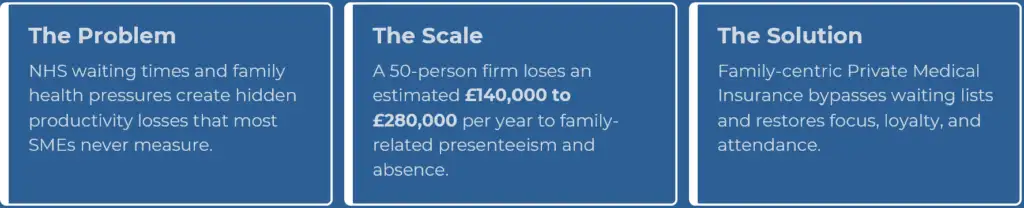
Most UK SME owners manage risk by looking at their order books, their cash flow, and their health and safety logs. Yet there is a category of risk that sits outside all of these measures, quietly eroding output, focus, and team stability. We call it the Family Factor.
When one of your key employees has a child on an eighteen-month waiting list for a specialist, or a spouse struggling with a hip that should have been repaired a year ago, that employee is not fully present at their desk. They are experiencing a specific kind of presenteeism, where anxiety about a family member’s health reduces cognitive focus and measurable output. They are physically in the building, but a meaningful portion of their attention is elsewhere.
This is not a speculative figure. It is derived from established absence cost modelling applied to realistic rates of family health distraction across a mid-sized workforce.
This report sets out why supporting the whole home is no longer a generous gesture reserved for large corporates. It is a practical necessity for any SME that wants to retain experienced staff, sustain performance, and stand out in the labour market.
The Productivity Paradox
The Absence Crisis
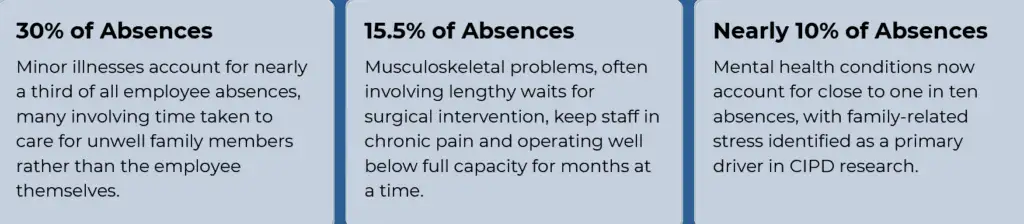
UK sickness absence reached a record high in 2024. The average employee took 9.4 days off, representing a 61% increase on pre-pandemic levels. Those figures are significant on their own. But the days your staff are not present are only half the story.
The Hidden Cost : Presenteeism
The days they are present but not performing are often the more expensive problem. A member of your accounts team is waiting to hear back from a consultant about their teenager’s diagnosis. A project manager is fielding calls from an older parent’s GP surgery. A senior salesperson is trying to reschedule a vital NHS appointment for the third time because the clinic cancelled.
In every one of these scenarios, the employee is at work, on the clock, and receiving their full salary – but their concentration is divided. Employees dealing with unresolved family health concerns make more errors, think less creatively, make slower decisions, and find it harder to lead or motivate others.

Who Is Most at Risk: The Sandwich Generation
The employees most exposed to family health pressures are frequently your most valuable ones. Staff in their 40s and 50s tend to hold the institutional knowledge, client relationships, and leadership experience that took years to build.
They are also the generation most likely to be managing health concerns on two fronts at once.
They are often raising children who need GP appointments, dental referrals, CAMHS assessments, or specialist consultations. At the same time, they are increasingly involved in managing the health of ageing parents, arranging care assessments, attending hospital appointments, and navigating a system that was not designed for convenience. This is the sandwich generation, and they make up a significant part of almost every SME workforce in the UK.
Losing one of these individuals to a competitor, to burnout, or to a career break is not simply a recruitment cost. It is a knowledge and continuity risk that can take years to recover from.
The NHS Reality in 2026

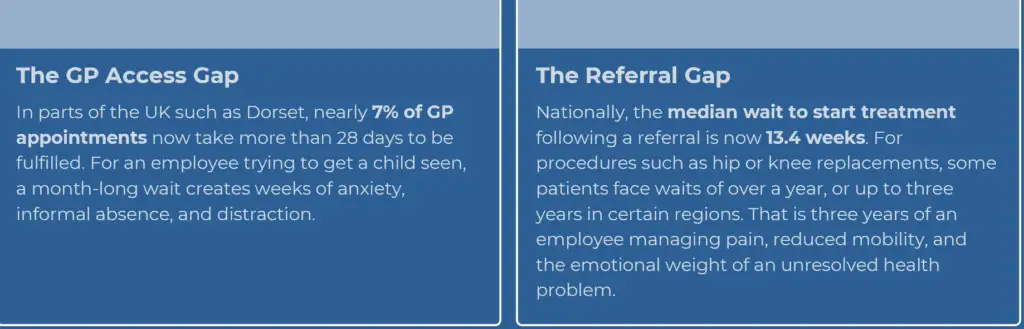
For your business, a thirteen-week wait for an employee’s child to see a specialist means thirteen weeks of phone calls taken in the car park, lunch breaks spent chasing referrals, and concentration broken by worry. The productivity cost is real. It is daily, cumulative, and invisible to any standard reporting system.
Quantifying the Cost to Your Business
Business owners are rightly sceptical of figures that cannot be traced back to a credible methodology. The cost estimates in this report are based on three components: the daily salary cost of a distracted employee, the frequency of family health events across a typical workforce, and the productivity reduction linked to unresolved health anxiety.



The Solution: Family-Centric Protection
Private Medical Insurance is often positioned as a corporate perk, something that large organisations offer alongside a gym membership and a company car. That framing causes many SME owners to dismiss it before properly considering the commercial case.
A more useful framing is that family-centric PMI is a cost-containment tool. It removes the waiting list problem entirely by giving employees and their families fast access to diagnostics, specialists, and treatment. The result is that health concerns get resolved quickly, anxiety is reduced, and the employee returns to full productive capacity far sooner than they would through the standard NHS pathway.
For many SME owners, the objection to family cover is the premium cost. That objection is worth testing against the productivity cost data in this report. In most scenarios, the net benefit of extending cover to families exceeds the additional premium cost within the first twelve months.
Same-day or next-day virtual GP appointments allow employees to consult a doctor about their child during a lunch break, recovering measurable working days each year.
VIRTUAL GP ACCESS Same-day or next-day virtual GP appointments allow employees to consult a doctor about their child during a lunch break, recovering measurable working days each year.
FAST TRACK DIAGNOSIS Moving from a worrying symptom to a clear MRI or CT scan takes days rather than months. Eliminating diagnostic uncertainty is one of the most powerful anxiety-reduction tools available.
MENTAL HEALTH & COUNSELLING Direct access to 24/7 telephone counselling and structured therapy for children and spouses can de-escalate family crises before they become extended workplace absences.
The Return on Investment for Employers
Extending PMI cover to employee families as a deliberate retention and productivity tool, rather than simply a perk, has been shown in published research to reduce absence duration by between 30% and 60%. For a 50-person firm, the modelled net annual saving exceeds £60,000 after premium costs, driven by three factors: reduced reliance on temporary labour, recovery of lost productive hours, and a measurable reduction in staff turnover.
The Turnover Cost – Staff turnover is consistently underestimated as a cost. The Chartered Institute of Personnel and Development estimates the average cost of replacing an employee in the UK at between £3,000 and £30,000 depending on seniority. If family-centric PMI keeps just two or three experienced employees per year who would otherwise have left for a competitor, the scheme has paid for itself in recruitment savings alone.
Three Pillars of ROI
| Reduced Absence Duration | Productivity Recovery | Staff Retention |
| 30-60% fewer temp staff costs through faster resolution of health concerns. | Less presenteeism and lower error rates as employees return to full cognitive capacity sooner. | Lower recruitment costs and preserved institutional knowledge when experienced staff choose to stay. |
There is also a compounding effect that standard ROI models do not capture. When employees see that their employer has invested in their family’s health, trust and loyalty strengthen. Discretionary effort increases, non-urgent sickness absence falls, and staff stay longer. Over three to five years, these effects add up to a real competitive advantage

A Note from Nigel: The Human Side of the Data
A team that knows you have their back when it matters most is a team that gives you their best when it matters most. That is not sentiment. It is the basis of every high-performing culture we have encountered in twenty-five years of advising businesses.
I am a father and a grandfather. I know that when one of my grandchildren is unwell, nothing else really matters until they are better. Your staff feel exactly the same way. That is not a weakness. It is what makes them good parents, good people, and ultimately good employees.
The data in this report gives business owners a clear framework for a decision that can feel like it should be an emotional one. If you need a financial case to support family PMI, this report provides it. But the human case is just as strong. Supporting your team’s family health is not about being a soft touch. It is about recognising that the whole person turns up to work every morning, not just the job title on their contract.
We take the time to understand your workforce, your budget, and your priorities, and find cover that fits. If you would like to explore what the numbers look like for your specific business, we are happy to have a straightforward, no-pressure conversation whenever you are ready. Use Link Here or go to insuremyhealth.uk
Sources and Further Reading
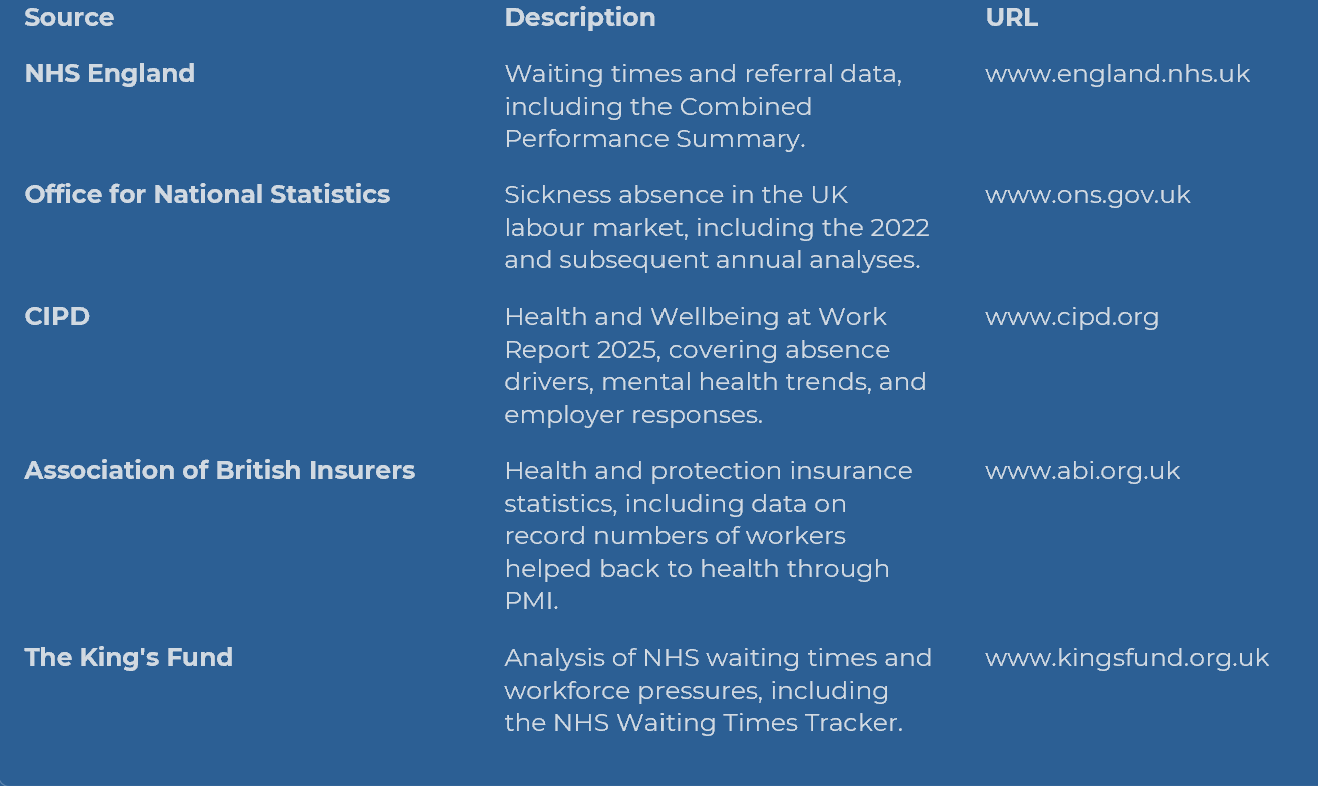
The data and analysis in this report draw on the following published sources. We encourage any reader who wishes to explore the underlying evidence to consult these resources directly.
Insure My Health is a trading style of Parkway Mortgages Ltd. Appointed Representative of The Right Mortgage and Protection Network. FCA No: 496104. This report is produced for general information purposes only. It does not constitute financial or medical advice. Independent advice should be sought before taking out any insurance product. © 2025 Insure My Health | insuremyhealth.uk